



11.28.2007
Flight canceled?? What Rule 240 means for you
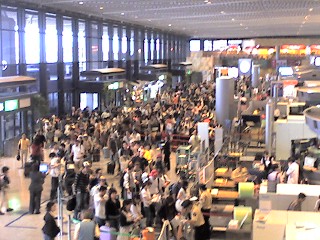
"Know if your carrier adheres to this rule — it could be your saving grace
Even though U.S. airlines have weakened the Rule 240 clauses in their contracts of carriage, it still pays to have a copy with you to show the airline's ground service agents what your rights are when your flight is badly delayed or canceled.
Before the deregulation of the U.S. airline industry in 1978, every U.S. airline had to follow the same set of rules — including those dealing with "irregularities" such as canceled flights.
In those days, airline fares and routes were regulated by the Civil Aeronautics Board, the predecessor to today's Federal Aviation Administration.
One of these rules, number 240, specified that if an airline couldn't get you to your destination on time, it was required to put you on a competitor's flight if it would get you there faster than your original airline's net flight. Airlines were even required to put you in first class if that's all that was available.
They rarely advertised this perk, however, since airlines naturally didn't want to fork over scarce cash to fly customers on a rival carrier. But seasoned road warriors have always known they could approach the counter and say the magic words "240 me" to be put on the next flight out.
Airlines formed after deregulation — such as JetBlue, Southwest, and Spirit — were never required to follow these rules. Even so, some of these newer airlines may attempt to put you on another airline if there's no other choice.
"While we don't have a traditional Rule 240, we will purchase confirmed seats as necessary on another airline to get customers to their final destination in the event of irregularities within our control," Todd Burke, JetBlue Airways' vice president for corporate communications, told Airfarewatchdog.com.
In addition, if there's a "significant delay," JetBlue's compensation may include a "partial or full refund," in addition to accommodation on another airline.
However, in recent years, as "legacy" carriers such as American, United, and Delta have struggled to remain profitable, and some have slashed costs to emerge from bankruptcy, many have quietly weakened their Rule 240s.
United Airlines, for instance, no longer states in its contract of carriage that it will fly you in first class on a competitor, if that's all that's available, although it will transport you in coach class on another airline.
Although Delta Air Lines still has a Rule 240 in its contract, it no longer makes any mention of transporting passengers on other airlines in the event of a flight disruption.
Continental Airlines will upgrade a delayed passenger only on its own flights—not on a competitor's—and only if doing so will get you to your destination earlier than would otherwise be the case.
US Airways has nothing in its terms of transportation concerning Rule 240, though spokesperson Amy Kudwa said the airline still applies the rule on all flights except international flights.
The good news is that Northwest Airlines still has a very traditional contract, little changed from the days of regulation. It will put you on another airline, in first class if necessary, if your original flight is delayed 60 minutes or longer.
It's important to emphasize that these rules generally apply to situations within the airline's control, such as mechanical problems. But if the flight irregularity results from a "force majeure event" such as bad weather, a riot, or a work stoppage, then all bets are off. And the legacy carriers may not have agreements with their newer competitors such as JetBlue and Southwest, so that they might not re-route you on those carriers.
Even if you are flying an airline that adheres to Rule 240, its employees may be reluctant to rewrite your ticket on a competitor because of the financial implications of doing so. So it pays to print out and carry a copy of the contract of carriage and present it to the gate agent if necessary." By George Hobica [Via msnbc.msn.com]
The Pointswizard.com Spin:
Know your rights. We did another post on this topic on April 7. 2007
Labels: Airlines, Continental Airlines, Delta Airlines, Northwest Airlines, rule 240, United Airlines, US Airways


9.14.2007
Eight ways to avoid air travel delays

"These days it may feel like a miracle if your flight arrives on time, but the truth is flights have always been subject to delays—whether they're caused by stormy weather, mechanical problems, or something else entirely. When one airport experiences delays, it can cause a ripple effect across the entire country within minutes. You've experienced the ripple effect if you've been told that weather delays in Orlando are holding up your flight from Las Vegas, where the skies are sunny.
But it's not your imagination if you suspect the delays have gotten worse in recent years. Doug Church, spokesman for the National Air Traffic Controllers Association, attributes "overscheduling [at the] busiest airports" to increased delays. Church explains that "at New York (JFK), the airlines have scheduled more than 50 flights to depart in one hour's time on weekday mornings. Yet the airport can only safely depart 45 aircraft when the weather's good. The resulting overflow of delayed aircraft spills into the next hour, and the next, and so on."
Throw in pilots reaching their maximum work-hour limits, and other crew and employee shortage problems ... and you have the summer of 2007. There is no flexibility left in the system, either the airlines' operations, or the busy airports."
Lisa Wright, a captain for Delta Connection carrier Big Sky Airline, says "from my perspective, weather is primarily the cause for delays. The next most frequent cause would be [equipment breaking], and the next would be crew availability and scheduling issues."
What are your rights if your flight is delayed?
The Aviation Consumer Protection Division of the Department of Transportation (DOT) explains that because airlines don't guarantee their schedules, passengers don't have many—if any—rights when delayed. The federal government does not require airlines to compensate passengers affected by a delayed flight. If your flight is cancelled, however, most airlines will re-route you on another flight.
Instead of simply praying for an on-time arrival or departure, practice the following defensive measures before you travel to help ensure you aren't negatively affected by air-travel delays:
1. Avoid delay-prone flights: Airlines publish on-time averages for their flights. Before you book, make sure you're on a flight that has a decent chance of arriving on time.
2. Know your airline: Certain airlines (ahem, Northwest) are known for labor disruptions and major incidents of flight cancellations and delays. Save yourself the hassle and fly another carrier whenever possible. The DOT publishes a monthly Air Travel Consumer Report http://airconsumer.ost.dot.gov/reports/ with statistics of delayed and cancelled flights. Try to avoid the worst offenders.
3. Book a non-stop: If your flight goes directly from City A to City B, you won't get stuck in a connecting city along the way. Remember that a direct flight is not non-stop.
4. Fly mornings: Whenever possible, book the first flight of the day. Delays tend to worsen throughout the day, so if you're first in the air, you'll be able to avoid many delays. Additionally, since the busiest times to travel are Mondays through Fridays from 7:00 a.m. to 10:00 a.m. and 4:00 p.m. to 8:00 p.m., traveling on Tuesdays, Wednesdays, and Saturdays may improve your odds.
5. Leave enough time for connections: When booking, assume that your departing flight will leave late and plan your connection time accordingly. Schedule at least one hour for a connection—particularly important if your itinerary calls for stops in Atlanta, Chicago (O'Hare), Los Angeles, or any of the New York area airports. Give yourself even more time if you have to change airlines or go through security again.
6. Use small airports: Avoid airline hubs whenever possible. "Secondary" airports are usually less congested and less prone to delays.
7. Know the rules: Familiarize yourself with your airline's rules for identification, baggage limitations, and check-in and gate times. If you're late checking in or showing up at the departure gate, you may miss your flight. Late passengers are also the first to be involuntarily bumped. Having to gate-check your too-large carry-on can cause delays as well.
8. Be early: Arrive at the airport with plenty of time to park, check in, and pass through security. You can find average TSA wait times for every airport in the country before you leave for the airpor" [Via USATODAY.COM
The Pointswizard.com Spin:
Go to the website below and print out and take with you a copy of Rule 240 for the airline you are traveling on.
http://www.mytravelrights.com/travellaw.cfm?ai=3
4.08.2007
Rule 240: Don't Leave Home Without It! - your secret weapon for fighting airline delays, cancellations, and missed connections:

Here's your secret weapon for fighting airline delays, cancellations, and missed connections:
Rule 240.
Before airline deregulation in 1978, Rule 240 was literally a federal requirement. Nowadays, it's a term describing what individual airlines will do for late or stranded passengers. In fact, the major airlines have filed "conditions of carriage" with the U.S. Department of Transporatation (DOT) guaranteeing their respective Rule 240s.
If your flight is delayed or cancelled, or if you've missed your flight connection, these policies may give you free meal vouchers, hotel accommodations, phone calls, and other amenities. You may be booked on a substitute flight -- even on another airline -- and you may be compensated or given a full refund if the flight problems persist.
How can you use Rule 240 to protect your rights?
Always carry a printed copy of your airline's Rule 240. Though the DOT requires airlines to keep a Rule 240 copy available for passengers at every ticket counter, don't count on that.
(Click on your airline's name below for a copy of its official Rule 240.)
Read Rule 240 carefully before you use it. Many airline ticket agents do not know these policies, so you should be the expert
For example, Rule 240s generally apply only to delays that are absolutely the airline's fault, such as mechanical delays. They do not apply to what the airlines call "force majeure" events: weather, strikes, "acts of God," or other occurrences that the airlines say they cannot control.
Be polite but very firm about your rights under Rule 240. You'll win most battles at ticket counters when you say the phrase "Rule 240" and show the agent your printed copy of the airline's policies. However, don't hesitate to keep going up the chain to supervisors if you're not satisfied. Sometimes, airlines will even go beyond Rule 240 requirements in the name of customer service. (Not always, but it's worth a shot!)
The Pointswizard.com Spin:
click blue line above , then scroll down and find the airline you need-click and then print it
Labels: airline, rule 240, travel rights
